The second album, released July 9, 1996, was tighter, shorter and more song-shaped than Ruby Vroom, and it produced the band's best-known song, "Super Bon Bon." It was also where the internal fault lines first showed up in public.
Choosing Kahne
The plan was to go back to Tchad Blake, but a death in Blake's family forced him to step away. According to Wikipedia's account, Doughty then hired David Kahne (Fishbone, the Bangles, later Sublime and the Strokes) over the objections of both his bandmates and Slash, wanting a tight, jittery, new wave-flavored follow-up rather than more of Ruby Vroom's sonic sprawl. Kahne produced most of it; Steve Fisk did two tracks, "White Girl" and "4 Out of 5," and the band self-produced one, "How Many Cans?"12
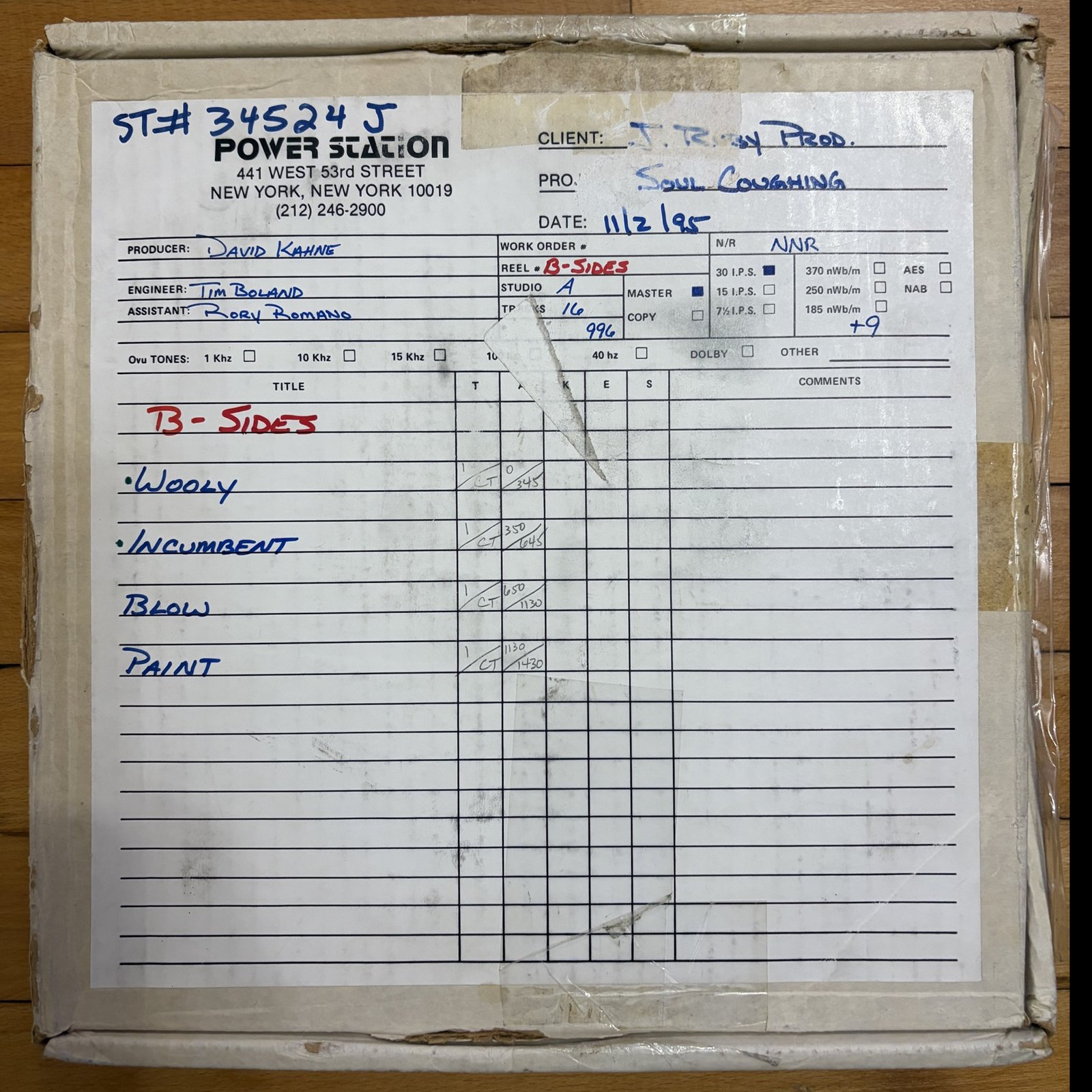
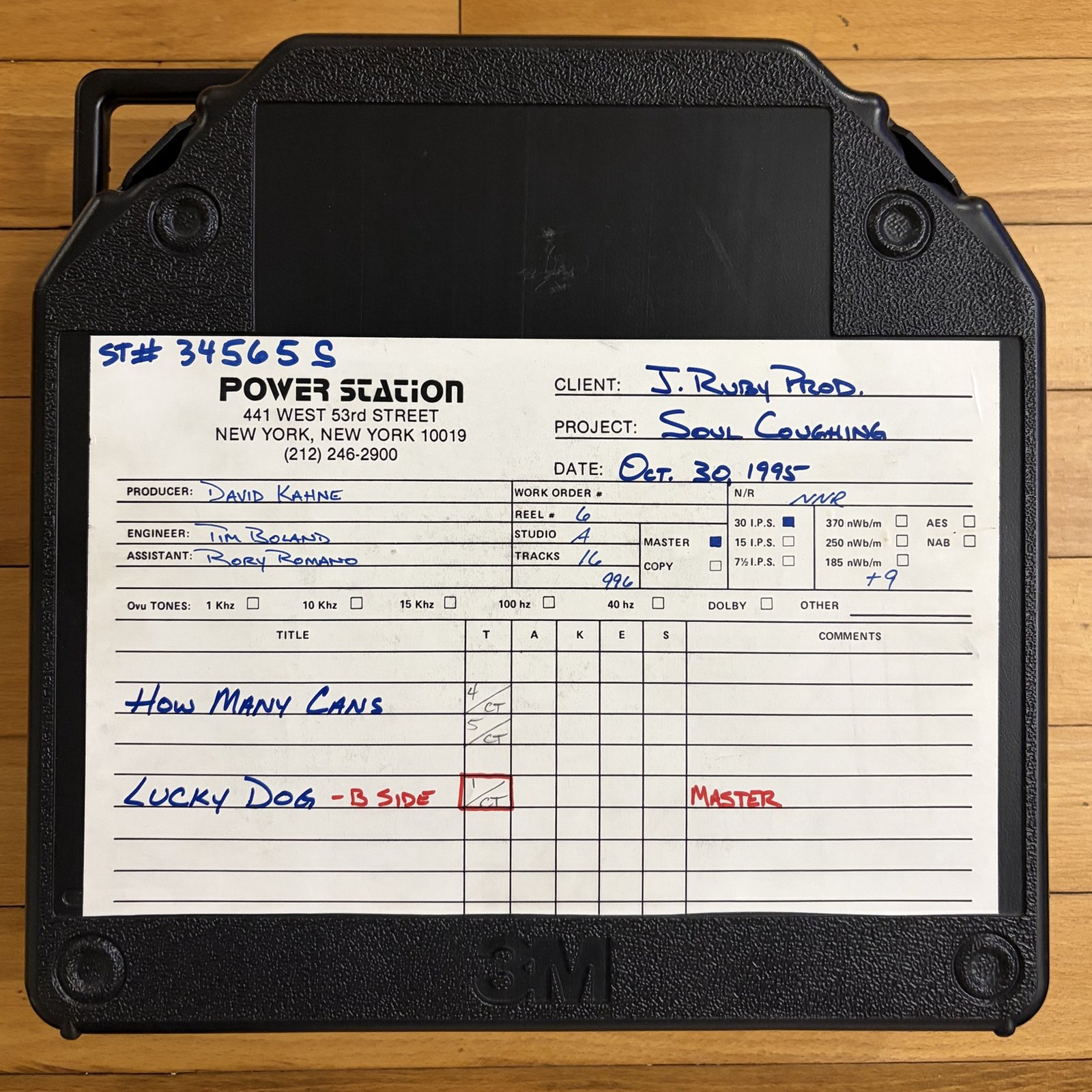
Tracking at the Power Station in Manhattan took eleven days, and Doughty was thrilled with it. The tape boxes put those sessions in late October and early November 1995, in Studio A with Tim Boland engineering and Rory Romano assisting, on 16-track tape running at 30 ips. Mixing was split among Kahne, Chris Shaw and Blake, and Blake stepped in partly because Steinberg briefly quit the band during the process. It turned into a bake-off. About half the album and most of the B-sides were mixed by at least two people: Kahne at Sony, Sear Sound and the Power Station, Blake partly at Sunset Sound Factory in Los Angeles, and Bil Emmons at Sear on the songs he had engineered there. Gabay later told a reporter that the second record is always the hardest and that everyone arrived carrying a big sack of puppies, a nod to the Hello CD track. Gabay's own account, from a 1997 St. Louis Post-Dispatch interview, is that the basic tracks went smoothly and took about half the time they'd planned, roughly a week. Then came the mix. The band is particular about how it sounds, he said, and they weren't happy with what they were hearing, so they kept trying another mix and another mixer until they were. "It was a very tough record to make," he said.34
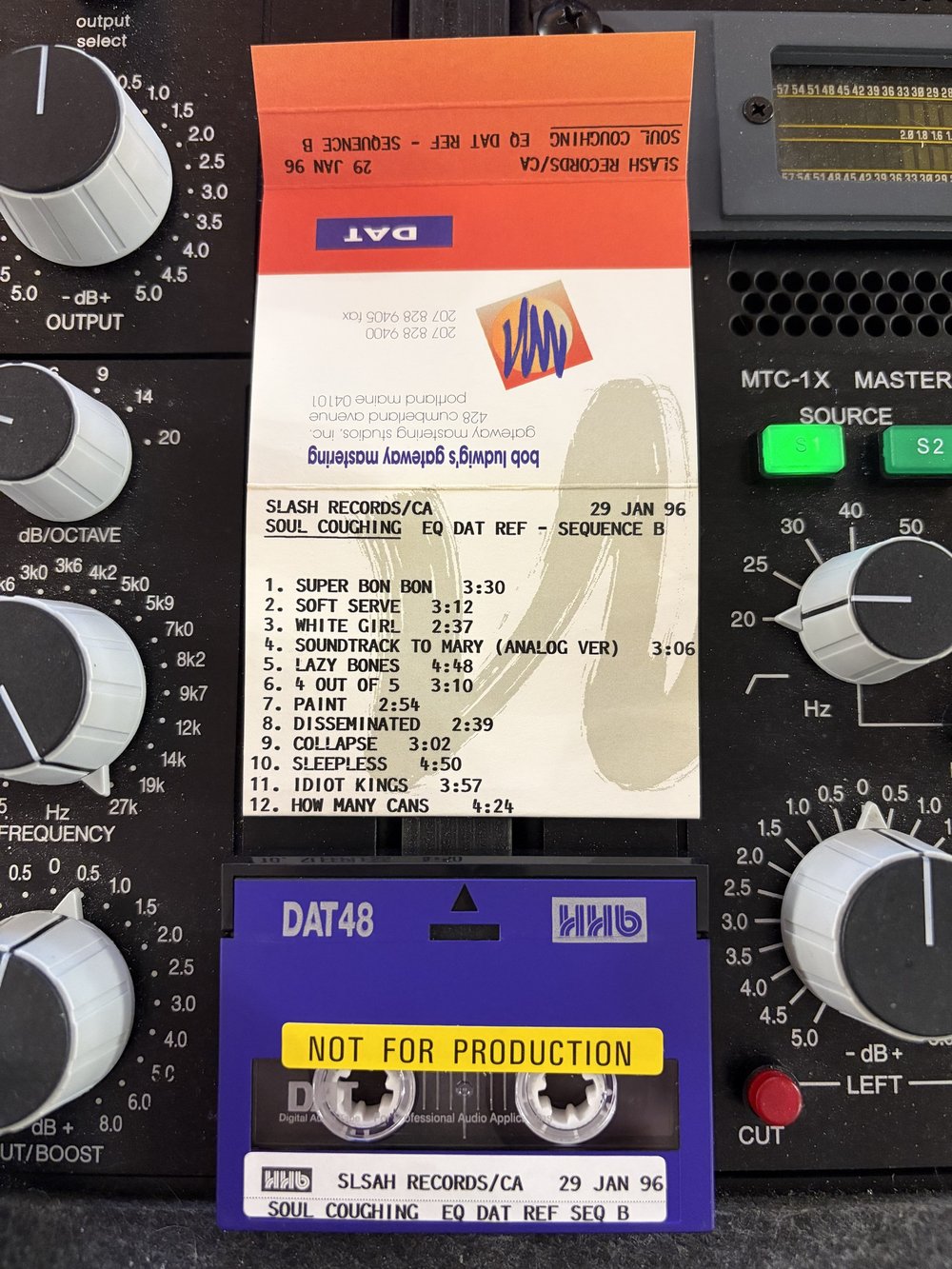
The mastering reference tape survives too. It came from Bob Ludwig's Gateway Mastering in Portland, Maine, dated January 29, 1996, and is labeled "EQ DAT Ref, Sequence B," with a yellow "NOT FOR PRODUCTION" sticker on the cassette. Presumably there was a Sequence A. All twelve songs are in the order the album would ship with, "Super Bon Bon" (3:30) through "How Many Cans?" (4:24), and track 4 is marked "Soundtrack to Mary (Analog Ver)." That is more than three months before the original May 14 release date, and well before the July 9 date the album ended up with.
They cut more than the album. On October 30 they tracked a different version of "How Many Cans?" from the one that made the record, and "You Lucky Dog," marked as a B-side. On November 2, a reel labeled "B-Sides" got "Woolly Imbibe," "The Incumbent," "Blow My Only" and "Paint." "Paint" made the album anyway, "Blow My Only" ended up a Japanese bonus track, and a song called "The Incumbent" finally surfaced three years later on El Oso, by then fused with another song.
Kaufman caught the band in Chicago for two sold-out nights at the Double Door, a week after Irresistible Bliss hit shelves, with the crowd already chanting the choruses back. By the magazine's count they had played 190 dates in a single year (it said 1994, though the gigography suggests 1995 is the likelier year) and had just traded the van for a slightly used tour bus, its front lounge stacked with Otis Redding, Sam Cooke, Desmond Dekker, Duke Ellington, Sun Ra and jungle compilations they had taken as payment for an in-store with no monitors and no PA. Doughty worked "Wonderwall" into "True Dreams of Wichita" ("after all, you're my Tylenol / my McCartney, Paul"), played the first night with an impacted wisdom tooth, and had it pulled the next afternoon between an in-store and the show, crediting the second night to a substance that "begins with an 'n' and ends with an 'ovacane.'"
Steinberg and Gabay were candid about the record. Ruby Vroom had been "a whole new language for a band," Steinberg said; this time they had figured out their sound "and wondered what it would be like to work with someone who was very 'professional.'" Both admitted Kahne's staff-producer approach didn't mesh with the experimental vibe they had chased with Blake, but they rose to it. "I think the sound has changed," Steinberg said. "It's deepened... this one is darker and more refined." Degli Antoni maintained the record held as many samples as Vroom, if not more, just home-brewed and less obvious rather than lifted from his record collection, even as some critics were already slapping it with the "sell-out pop record" label.
The Songs
Doughty told Rolling Stone in 1996 that everything he writes is an open letter to an ex-girlfriend, and admitted he sometimes forgets to change the details. He expected to be able to call "White Girl" an amalgam, he said, but it had turned out to contain so many specifics about one former girlfriend that he would have some explaining to do. On 120 Minutes in January 1997, Doughty described the album's lyrics as "paranoid love songs," more about resistance than bliss. He had been dumped while the band was on the road, and back in a cold, drizzly New York with the phone ringing, he said, he sat in his apartment in a fetal position with a notebook. That, he said, is where the record came from. He added that the band isn't a somber goth act and that the lyrics are mostly about how the words sound.5
Gabay told the Houston Press the shorter forms came straight from playing big rooms night after night: large halls punish long gestures. Only three of the twelve tracks run past four minutes ("Lazybones," "Sleepless" and "How Many Cans?"), and the whole record clocks in around 45 minutes. He also described rescuing "Collapse," a song they had dropped from the set because it only worked once, by writing a new beat and rebuilding the bass and vocal around the old melody.6
Degli Antoni kept his sampling habits. He hinted to SCUG in 1996 that a Daryl Hall sample was hidden somewhere on the record and refused to say where. Studio legend Walter Sear plays theremin on "4 Out of 5," doubling Doughty's melody in the left channel during the second verse.7
The song's original working title was "Got to Get Some Smokes." A rehearsal DAT carries that name.
Warner's own 1996 materials date the recording to the second half of 1995 in New York. In a Warner online chat from Lyon that September, Doughty gave unusually direct readings of the songs:8
- "Super Bon Bon": a guy pushing through a crowd, speeding up and convinced that if he keeps accelerating he'll levitate; also about being haunted by a lover's pet name. On 120 Minutes in January 1997 Doughty gave the word's origin: a Super Bon Bon is an Italian candy bar, he saw it at a truck stop in Italy, and he spent the next three hours repeating it. He said he catches words the way other people catch colds.
- "Collapse": a record company executive murdered in a hotel room, set against a big company swallowing a smaller one (more specific than the anti-consumerism reading critics usually gave it).
- "Disseminated": the names in the second verse belong to people he met on vacation in Jamaica; the opening clarinet is a sample of Raymond Scott's "The Penguin," and the credits share the songwriting with him.
- "Soundtrack to Mary": simply a love song.
- "Unmarked Helicopters": written specifically for the X-Files album as a kind of fairy-tale comment on the show. (For the 1998 film's album, "16 Horses" came about, Doughty told MTV News, when David Was invited them to do another after the first one. He came to a rehearsal, heard them play, and picked the song. Doughty admitted he'd forgotten the movie was coming out.)
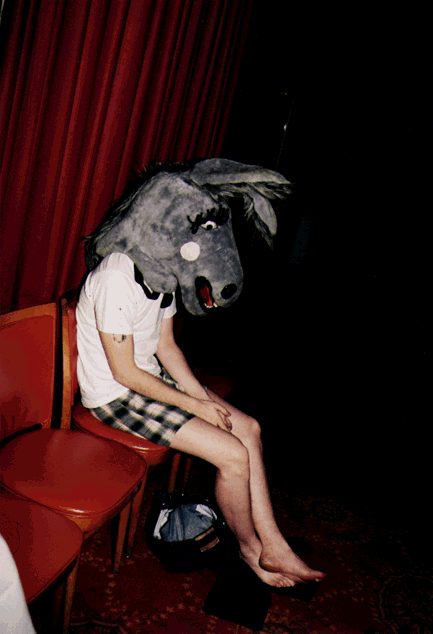
The stuffed grey horse on the cover belonged to their friend Frank, the album's art director.
Title and Cover
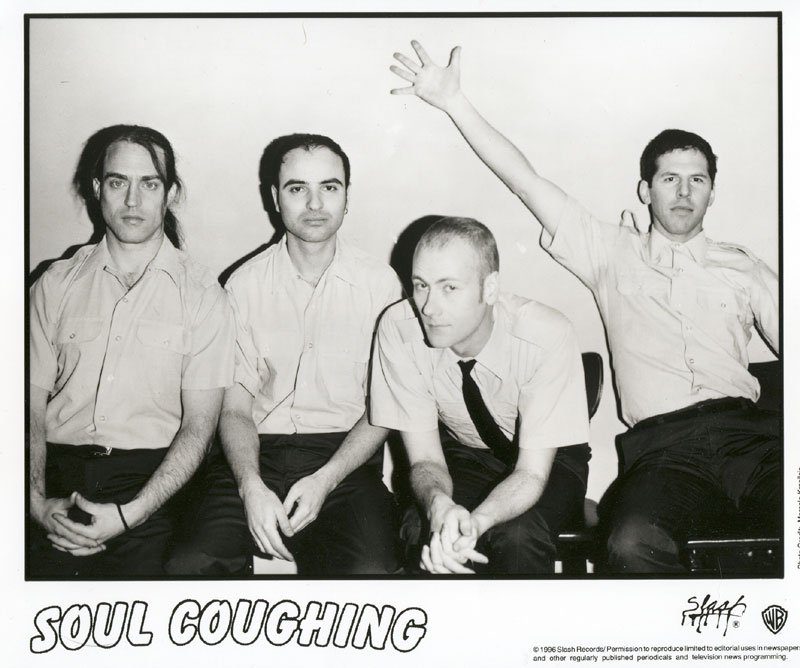
The title riffs on Doughty's favorite Prince song, the B-side "Irresistible Bitch." Doughty described the record's lyrics as anxious love songs, wanting someone to call and dreading the phone ringing, and said that for him the album was more about resistance while for the other three it was more about bliss. The man on the cover is Steinberg.
Release and Singles
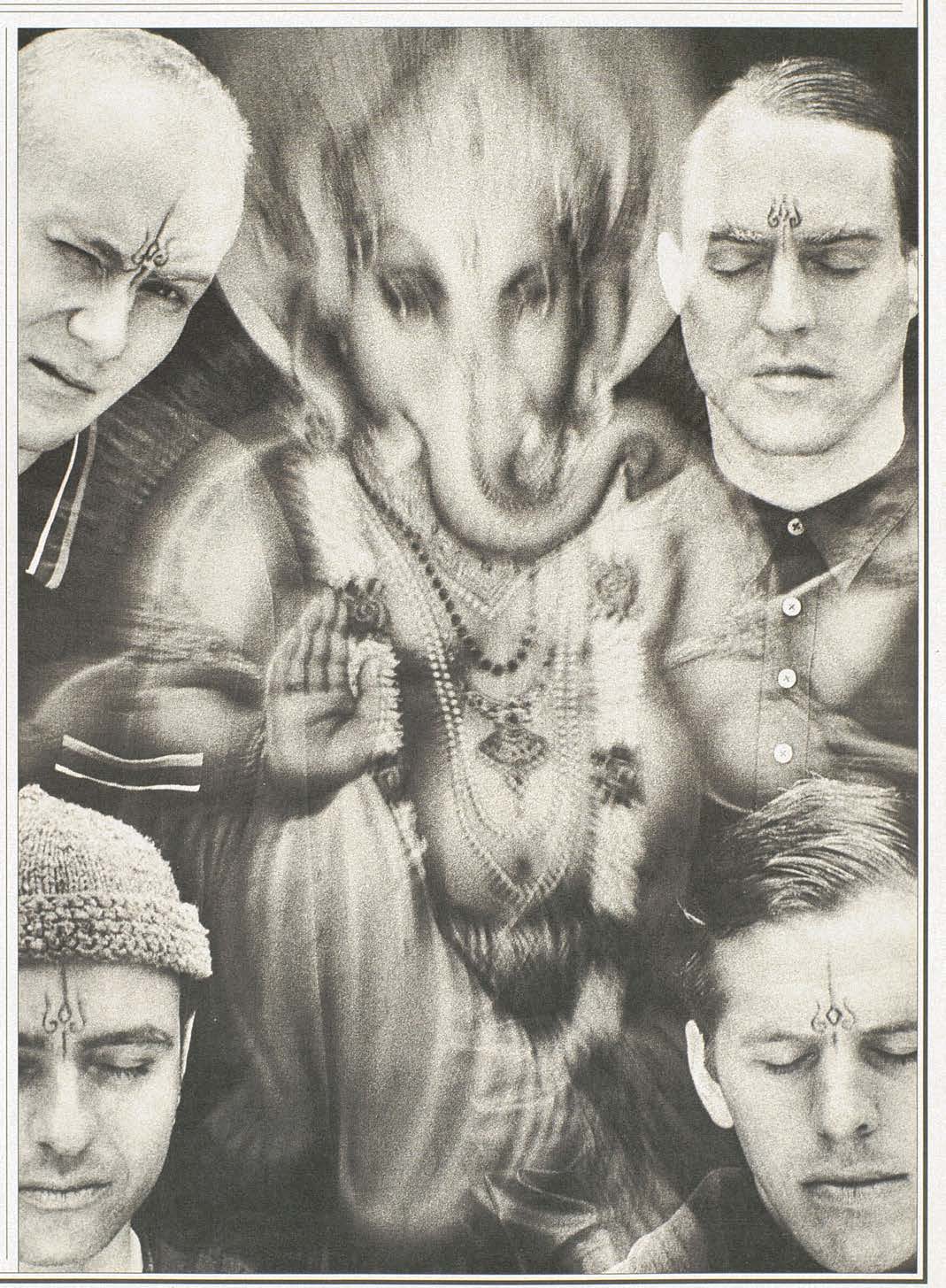
Rolling Stone ran David Sprague's profile in its May 30, 1996 issue, headlined "Soul Coughing hack out a hearty blend of Beat poetry, hip-hop and art rock." Sprague followed the band to Asbury Park, New Jersey, for a one-off warm-up show at the Stone Pony before their European tour, the first time they had played many of the new songs for a crowd. He found Steinberg and Gabay slow to lock into their trance groove. "You got to see us scrape off the first layer of rust," Steinberg said afterward. Doughty, then 25, said the group had wanted to see what a Soul Coughing pop record would sound like, which is why they chose Kahne. Doughty called the band "totally a co-op." He, Gabay and Steinberg lived within a block of each other in Fort Greene, Brooklyn, while degli Antoni had just bought a house in his native San Francisco. Gabay, then 33, said living there meant you always heard the newest music, from subwoofers to dancehall, "without people getting uptight." Steinberg added that he and Gabay had been playing that kind of thing before there was hip-hop. The article put Ruby Vroom at about 70,000 copies by SoundScan and said Irresistible Bliss was recorded in under two weeks, with more tension than they'd expected.5
The release slipped while the label debated pushing "Unmarked Helicopters" from The X-Files compilation as a single. Fox wanted the song on radio and video to sell its soundtrack, so Irresistible Bliss went from May 14 to July 9, and then the video fell through anyway over scheduling with the show's crew. Europe got the album on schedule in May.9 Advance CDs had already gone out with the May 14 date printed on the back, under a line from Doughty: "Soul Coughing is sort of this V.U. meter, with Heartbreak on the left, and Nonsense on the right. The needle twitches from one side to the other, usually."10 Gabay complained to the Houston Press that the label was simply too slow. When it finally landed it reached No. 136 on the Billboard 200.611
A snapshot of where the band stood just before release: MIT's student paper The Tech reported on April 19, 1996 that Soul Coughing would headline the school's Spring Weekend on May 3 at Walker Memorial for a $3,000 flat fee, chosen because that year's budget was smaller than usual (previous headliners included They Might Be Giants and Sonic Youth). A Newbury Comics clerk who had heard an advance copy said Irresistible Bliss was due May 14, about two months before it actually came out, and most students the paper polled had never heard of the band.12
| Single | Year | US Alternative Peak | Video |
|---|---|---|---|
| "Soundtrack to Mary" | 1996 | No. 37 | John Flansburgh and Norwood Cheek |
| "Super Bon Bon" | 1996 | No. 27 | Jamie Caliri |
| "Soft Serve" | 1997 | Did not chart | None listed |
Steinberg told the Philadelphia City Paper that the band was spending the Fourth of July 1996 shooting a video at Roadside America in Pennsylvania, with Flansburgh directing.13
The 1998 press bio claimed the album sold over 250,000 copies. Japanese editions added "Lemon Lime" and "Blow My Only," plus a bonus disc with a Propellerheads remix of "Super Bon Bon" and live tracks.14
Fan reviews from the time, like Stephen Lin's, heard the same shift the band described. Lin found the production cleaner than Ruby Vroom's rawer sound, which made the contrasts between songs more in-your-face, and he heard a harder edge overall, with "Super Bon Bon" swinging from head-nodding groove to near-seizure rock. He singled out the samples (elephants, slowed voices, clarinet ensembles, strings) for working even when they didn't sit exactly in tune with the band, and pointed fans to "Unmarked Helicopters" as an eerie outlier.
"Super Bon Bon" became the band's most durable song. It turned up in ECW wrestling entrances (Danny Doring and Roadkill, 1998 to 2001), Gran Turismo 2 (1999), Homicide: Life on the Street, The Sopranos, The Last Dance and Reacher. "Disseminated" scored a 2006 Ford Transit ad, minus its opening line about a goat digesting a Ford sedan.
Degli Antoni told fans in a March 2000 SCUG chat that "Super Bon Bon" began as a groove of his that Steinberg and Gabay locked onto instantly; Doughty took a couple of days to find words, and for a while it was called "I'm Going to Get Cigarettes." The final title came from a candy bar, which Doughty had acknowledged in writing. In his February 2000 New York Press column "Ricky Don't Lose My Number," he said he spotted a Super Bon Bon bar in a truckstop near the Swiss and Italian border on a European tour and chanted the name all the way to Milan.15 That undercut any claim against Ricky Martin's later "Shake Your Bon-Bon," which the band had considered; Degli Antoni said nothing was ever litigated. He answered it his own way instead: in late 1999 he made the "Desperado Mix" of "Super Bon Bon," folding "Shake Your Bon-Bon" right into it, so anybody could hear the resemblance for themselves. It went up as a download in February 2000 and stirred up enough fuss that it stayed up an extra month.16 Doughty's own take was a shrug: everyone he knew kept calling to tell him Ricky Martin owed him money, but a band their size had no way to take on Sony's lawyers.15 Around the same time an IMAX Michael Jordan film was asking for a hip-hop mix of the song.17
1996 and 1997 on the Road
Firewater, Tod A.'s band after Cop Shoot Cop, opened dates on the winter 1997 run. Gabay was part of Firewater as a side project, having met Tod on the band's first tour, but he told Orange Source he wasn't playing with them on those dates.18 Musician's January 1997 notice of Firewater's debut, Get Off the Cross (We Need the Wood for the Fire) (Jetset, October 1996), listed him among the "day job" players behind Tod A., next to Duane Denison of the Jesus Lizard.19
The band played the second stage on the southern leg of Lollapalooza 1996, booking extra headline dates to reach cities the festival skipped, then joined the 1997 H.O.R.D.E. tour with Neil Young and Crazy Horse, Beck and Morphine. Contemporary Musicians says the New York H.O.R.D.E. date was webcast live by SonicNet, one of the first concert broadcasts online. They had streamed a show before that: on April 30, 1996 they played two sets live over the Internet with RealAudio, at RealAudio's first-anniversary party during the Internet World convention in San Jose, carried through the band's page on Warner's site.20 Their first appearance on MTV's 120 Minutes, hosted by Matt Pinfield, came in January 1997 (the show lists it as January 27). Asked about the upright bass and the jazz in the music, Steinberg said the New York subway was about as big an influence as jazz. Asked if he had ever played in the subway, he said no: he just wanted to be the subway, and bass was the next best thing. In 1997 they also appeared on HBO's Reverb, played "Super Bon Bon" live in the studio for Howard Stern, placed "The Bug" on the Batman & Robin soundtrack, and paired with Roni Size on "A Plane Scraped Its Belly on a Sooty Yellow Moon" for Spawn.2122
That June they also took a commercial gig, scoring the Gap's "Fall Into the Gap" TV ads, which ran that fall (here's one). They did not do it halfway. The final mixes DAT holds three pieces, each about 30 seconds long, cut 32 different ways: straight music, a bass tag, a Doughty tag, a "true Doughty tag," a "Doughty special tag," rap with no percussion, rap with no effects, rap only. Somebody at the agency really wanted options. By September, "Fall Into the Gap" was on the newsgroup's list of songs going around on tape.23
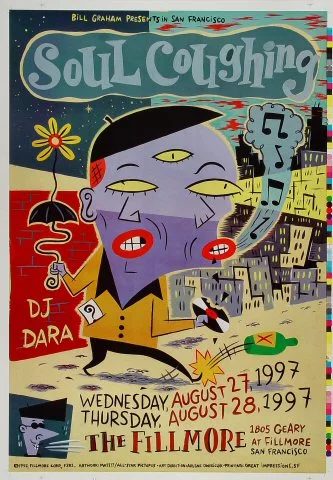
On the side, Doughty sang "Bond" on 808 State's Don Solaris, had four poems on the spoken word album PoemFone: New Word Order, and wrote a piece for Might magazine that drew enough response for the editors to offer him a column. Steinberg and Gabay recorded with Suzanne Vega and joined Marc Ribot in a project called People Who Only Need a Beat; Gabay also drummed on "Careless Santa" from Mono Puff's Unsupervised, and Steinberg played on Cibo Matto's "Birthday Cake." Degli Antoni was at work on a CD for John Zorn's new label.9 Doughty also recorded the solo acoustic album Skittish on July 5, 1996; Warner Bros. rejected it, and it would not come out until 2000.
Steve Keene
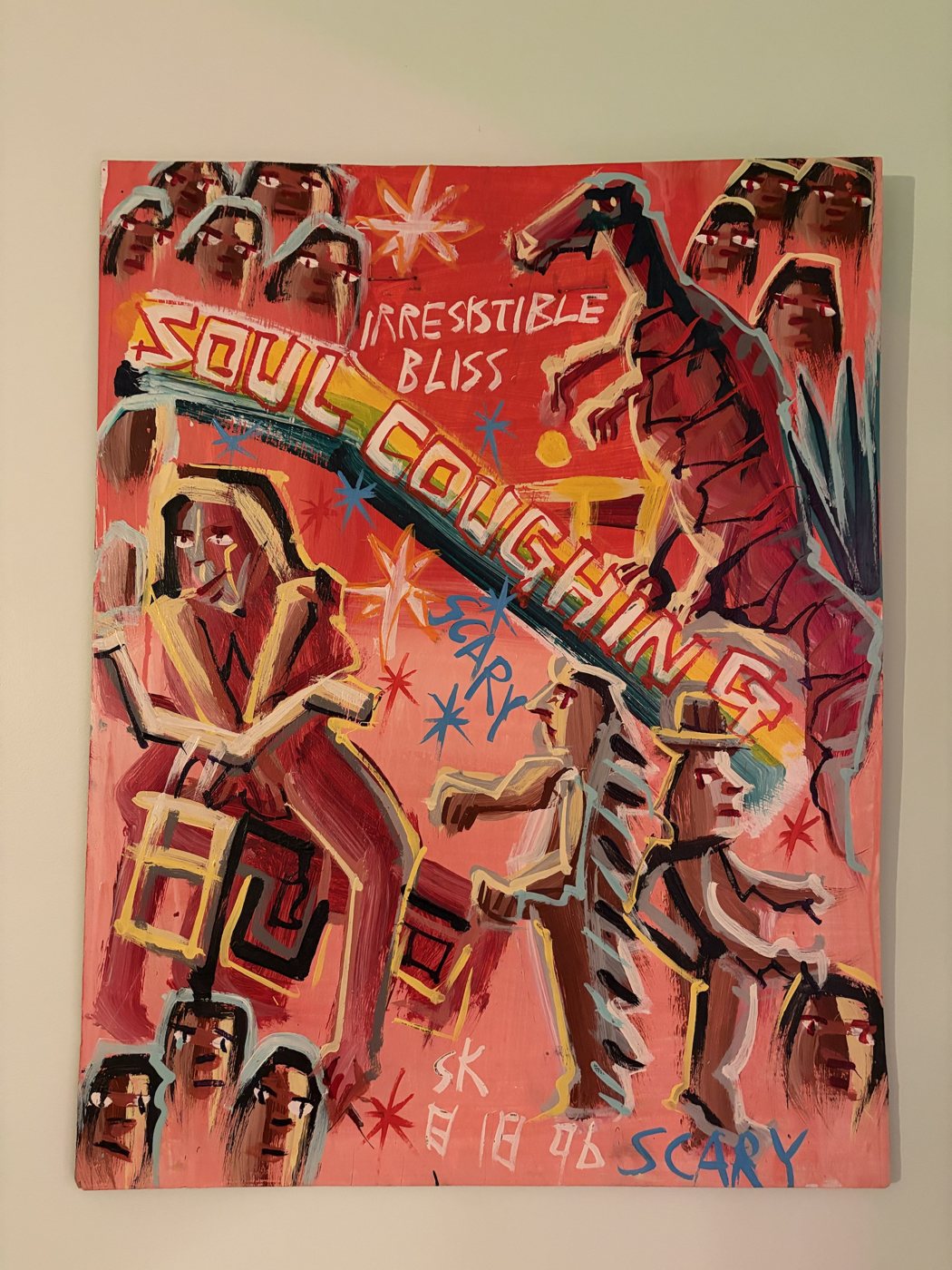
Steve Keene, the prolific New York painter, painted all of the band's tour road cases, around 1996 as the Irresistible Bliss tours got going. He also made a few one-off paintings with Soul Coughing back then.
Life on the Bliss Tour
Press from the fall 1996 run shows a band that had stopped being a New York secret. Steinberg told The Virginian-Pilot that October that Irresistible Bliss "reflects the fact that the band spent the past 18 months in vans just driving around playing," and that he was "not in the business of describing it, I'm in the business of making it." On the jump from clubs to arenas opening for Dave Matthews, including the December 30, 1995 show at Hampton Coliseum: "Five hundred people is a lot in a club. In a coliseum, it amounts to the janitorial staff." The same piece traced "Screenwriter's Blues" back to a keyboard loop and "The Idiot Kings" to four guitar chords, and recalled the band silencing an industry crowd at a Los Angeles showcase with "Screenwriter's Blues."24
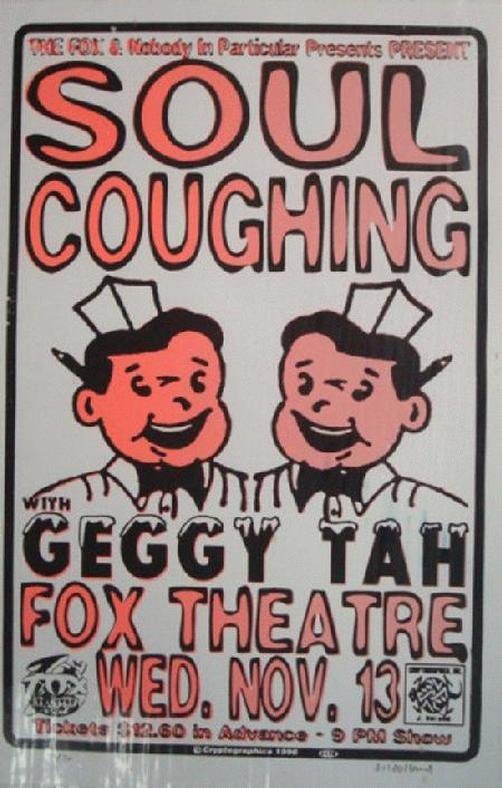
A Harvard Crimson reviewer at the Paradise in Boston that fall, after the band's Fleet Center dates with Matthews, counted a set of nearly two hours and called degli Antoni's sampling the most riveting thing on stage, "a genuinely original band that plays better live than on tape." In Austin, where they played Liberty Lunch on November 2, 1996, the Chronicle led with Doughty's Beverly Hills, 90210 habit: he called himself one of the world experts on Tiffani-Amber Thiessen, said he aspired to a genre called "90210 Rock" after seeing the Goo Goo Dolls on the show, and admitted the joke had turned into "this great marketing angle." Rumor had it Jennie Garth owned both albums.2526
Fans filled in the rest. At Liberty Hall in Lawrence, Kansas, on February 19, 1997, it was Steinberg's birthday, and Doughty narrated a mock biography between songs ("Sebastian Steinberg was born in 1905... Sebastian Steinberg was the first man in space") before a cake came out and the room sang. The same night the band was already trying out "I Miss the Girl" and the song with the refrain "let me get up on it," both of which would land on El Oso a year and a half later. That September, a fan on the newsgroup tallied a top-ten poll of 30 voters: "True Dreams of Wichita" edged "Down to This" on first-place votes, followed by "The Idiot Kings," "Super Bon Bon" and "Screenwriter's Blues." The full list of 52 titles is a snapshot of what was circulating on tape in 1997, including unreleased songs like "The Brooklynites," "Fall Into the Gap," "Michael Jackson," "Gotta Get Right With This," "Amy Fisher (I'm Livin' on Baby Food)" and "Thank You F Train."23
Doughty had his own rituals on those tours. He would get the whole room to yell their zodiac signs at once ("Everybody yell your zodiac sign!"), and when he introduced the band, degli Antoni was "Mark on the Heisenberg compensator."
The next record was already turning up in the set lists by then, and it was going to be a very different kind of record.
-
Irresistible Bliss Japanese edition booklet, London/PolyGram POCD-1222, 1996: credits, lyrics, and liner notes by Toru Watanabe, April 1996; shared by @osoarchive. ↩︎
-
Wikipedia. ↩︎
-
Allen Sculley, "Redefining Pop: Soul Coughing Lets the Drums and Bass Lead," St. Louis Post-Dispatch, February 20, 1997, p. 12. ↩︎
-
M. Doughty, tour Dispatches #1 to #4, AOL, November 1994 to February 1995. ↩︎
-
"Soul Men," Houston Press, July 1996. ↩︎↩︎
-
Mark degli Antoni, interview with SCUG, 1996. ↩︎
-
Warner Bros. Cyber-Talk with Doughty, Lyon, September 16, 1996. ↩︎
-
"News" and "What's New," The 5% Nation, March to October 1996, via the Wayback Machine. ↩︎↩︎
-
Irresistible Bliss advance CD, Slash/Warner Bros. 2-46175-A, promotion only, 1996. ↩︎
-
Billboard. ↩︎
-
The Tech (MIT), on the Spring Weekend show, April 19, 1996. ↩︎
-
Margit Detweiler, "20 Questions: Sebastian Steinberg of Soul Coughing," Philadelphia City Paper, July 4, 1996. ↩︎
-
Soul Coughing, El Oso press biography, Slash/Warner Bros., 1998. ↩︎
-
M. Doughty, "Ricky Don't Lose My Number," New York Press, vol. 13 no. 7, February 2000. ↩︎↩︎
-
"The News," The 5% Nation (soulcoughing.com), July 1999 to March 2000, via the Wayback Machine. ↩︎
-
SCUG chat with Mark degli Antoni, March 3, 2000. ↩︎
-
Sue Markert, "We Call It Soul Coughing," interview with Yuval Gabay, Orange Source, Syracuse University, March 3, 1997 (posted March 31, 1997). ↩︎
-
Robert L. Doerschuk, Firewater notice, Musician, January 1997, p. 15. ↩︎
-
PR Newswire, "Soul Coughing Concert to Be Broadcast Live over Internet Using RealAudio," April 24, 1996. ↩︎
-
"Soul Coughing," Contemporary Musicians, Gale, c. 1998, via Encyclopedia.com. ↩︎
-
SonicNet chat with Doughty and degli Antoni, September 12, 1995, and SonicNet show coverage. ↩︎
-
alt.music.soulcoughing newsgroup, 1996 to 2013, via UsenetArchives.com. ↩︎↩︎
-
"Evolving Soul Coughing Can't Be Pigeonholed," The Virginian-Pilot, October 18, 1996. ↩︎
-
Paradise Rock Club review, The Harvard Crimson, October 24, 1996. ↩︎
-
"Roadkill," The Austin Chronicle, November 1, 1996. ↩︎